Bottle Feeding Your Baby

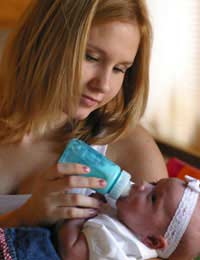
Babies who are not breastfed need to be bottle fed instead with formula milk. This is made from soy or cow’s milk modified to make it more suitable for a baby.
Getting Organised
Bottle feeding requires:- Bottles and teats. Have at least six 200ml bottles to start with. Different style teats are available – the smaller hole or ‘slow flow’ type might be best at first.
- Formula milk. Formula is sold in powder form or ready-made (more expensive but useful when travelling or on holiday). Most brands are available in newborn, older baby and toddler versions.
- A method of sterilising – for example, sterilising fluid, a plug-in steam steriliser, or a microwave steriliser. Alternatively, feeding equipment can be boiled for ten minutes
- A bottle brush for washing up (or use a dishwasher)
Making up a Feed from Powdered Milk
- Boil the kettle and allow it to cool
- Pour the correct amount of water into the bottle
- Measure out the correct amount of powder as instructed on the tin. Level off the scoop with a knife
- Shake the bottle until the powder dissolves
- Check the temperature of the milk on the inside of the wrist. It should feel slightly warm
Making up Feeds in Advance
It’s a good idea to make up several bottles at once and store them in the fridge. Warm the bottle by putting it into a basin of hot water until it reaches the right temperature. Using a microwave is not advised because of the potential for overheating or ‘hot spots’ which could scald a baby’s mouth.How and When to Feed
An advantage of bottle feeding is that other members of the family can help. Feeding is a great time for getting to know each other. Get comfortable, hold the baby close and tip the bottle so that milk completely fills the teat.It’s a matter of personal choice whether to feed on demand or to follow a routine. For the first few weeks, it’s probably easiest to let the baby dictate when it needs to be fed. Some mothers feed on demand at first and then follow more of a routine (for example, every three or four hours) as a pattern starts to emerge.
Some babies feed more frequently in the evening, but go longer between feeds earlier in the day. Some babies may start to ‘go through the night’ after only a couple of months; others may take much longer. There are no hard and fast rules.
After a feed, gently rub or pat the baby’s back to help bring up any trapped wind.
How Much to Feed
New babies only take one or two ounces at first. As they grow, they’ll drink more. If they stop drinking, it means they are probably full – it’s best not to make them take more. If a baby is drinking the whole bottle, try an extra ounce to ensure they are getting enough. On very hot days, a bottle of cooled, boiled water will help keep the baby hydrated.Steady weight gain, regular bowel movements and plenty of wet nappies are all signs that a baby is getting enough milk.
The Importance of Sterilising
It’s vital to keep feeding equipment scrupulously clean by sterilising, as warm milk provides a breeding ground for bacteria. Always throw away unfinished milk. Continue sterilising milk equipment for the first year and general feeding equipment for six months.Moving on to Cow’s Milk
Cow’s milk is best avoided as a drink until a child is at least one – although some dairy produce (such as yoghurt) can be introduced before that, as part of weaning. Formula milk is available for older children as well as babies, which has been specially designed with their nutritional needs in mind. A child can switch to whole cow’s milk at some time between 12 and 24 months, provided they’re eating a balanced diet. Formula milk has more iron than cow’s milk for example, so unless a child is getting iron from other sources, formula is preferable.Moving on to a Cup
Most babies can drink from a cup with a spout at around nine months, but some will be ready earlier, while others will want to hang on to their bottles – particularly at bedtime. Bottles are a source of comfort and many toddlers still enjoy using them if their parents don’t object! However, the older a child is before they give up their bottle, the harder it is likely to be. A gradual switch is probably the kindest way. Try replacing one bottle a day with a cup, then two, and so on.- Are Nuts Healthy?
- Healthy Eating to Avoid Diabetes
- Eating for Healthy Bones
- Why It's Good to Eat as a Family
- Why is Breakfast Important?
- Drinking Water: Why and How Much?
- The Correct Food Portion Sizes for Kids
- Milk Intolerance in Children
- When Your Child is Diagnosed With a Failure To Thrive
- From Breast to Bottle
- When and How to Wean Your Baby
- Breast Feeding Your Baby

Re: Superfoods on a Budget
I just checked out these fantastic tips for buying superfoods on a budget! Eating healthy doesn’t have to be expensive. Can’t wait to try…
Re: Fun Facts: How Many Calories Does a Child Burn?
hi, im eleven yrs. I weigh about 100 lbs and believe I am over the normal weight. I am about 4’10 ft. I…
Re: Fun Facts: How Many Calories Does a Child Burn?
I want to clear this up for everybody worried about their weight, especially at a young age you shouldn’t…
Re: Dealing with a Child that is Always Hungry
I am the great grandmother of an 8 year old that I mostly take care of her mom is around but she totally depends…
Re: Fun Facts: How Many Calories Does a Child Burn?
I’m 11 years old and recently got a smart watch. This isn’t a big question but I can’t find how many…
Re: Dealing with a Child that is Always Hungry
I'm immediately suspicious of an article that suggests cereal as a healthy snack. Cereal (especially cereal…
Re: Fun Facts: How Many Calories Does a Child Burn?
How many calories SHOULD an average twelve year old burn daily???
Re: Fun Facts: How Many Calories Does a Child Burn?
I'm 9 years old and I'm trying to set up a health journal but I don't know how many calories I should…
Re: Fun Facts: How Many Calories Does a Child Burn?
Hiw much calories should an average 10 year old burn a day?
Re: Dealing with a Child that is Always Hungry
I’m 16 and my sister is 11 years old 57 inches and weighs 90 pounds she only drinks like 2 or 3 16 ounce bottles…